Friday, September 30, 2016
Flight MH17 destroyed by a Russian missile
On 17 July 2014, a Boeing 777 bound from Amsterdam to Kuala Lumpur crashed in Ukraine, killing 298 passengers and crew. The Ukrainian army claimed that Russia was responsible for this crime, but Russia blamed Ukraine. Undeniable data confirms that the Boeing was indeed destroyed by a Russian missile. Click here [Pardon the publicity].


Birds of death are disappearing

Rafale jet fighters leave the Charles-de-Gaulle

TIMING : Here's the time at which the article reached my computer, transmitted by the franceinfo service :

A tweet on the subject wasn't published until an hour later.
Clearly, the news reached me well before Twitter picked it up.
Thursday, September 29, 2016


Bound to strike the buggers

Sailors, we’re all convinced that you’re sailing towards success. Towards a big battle… followed by peace in Syria and Irak. Happy sailing.
My brain hides unpleasant memories
This morning, unexpectedly, I suddenly found one of my favorite French songs floating through my brain, but I couldn't pin it down. Little by little, the melody started to shimmer in my memory, along with a few words, and accents of the singer's voice. But the singer's identity and the title of the song still failed to clarify themselves.
I immediately said to myself that some kind of a psychological obstacle was preventing me from obtaining a complete picture of this data stored in my brain. But there are ways to bring it back into view. Readers may have noticed that my brain has been working in overdrive for several months, simply because it has been “remastering” links that got messed up when I fell down the stairs last year. I promptly decided to start digging... as systematically as possible. I was convinced that, if I handled the situation calmly, but with determination, I would soon discover all the missing elements. So I simply lingered in the warm autumn sunshine and waited patiently, leaving my brain to search, like an obedient computer.
Within a few minutes, the singer's surname flashed onto my cerebral display screen: Moustaki. Fair enough, i remember being fond of this Greek-born singer, who made a name for himself in France.

But why would memories of this sympathetic singer lead to any kind of psychological obstacle in my brain? I recalled that, in 1993 (well before the singer's death in 2013), I had in fact attended a concert in which he performed, at St-Pierre-de-Chartreuse, as part of the village's annual festival in honor of the great Belgian singer Jacques Brel, who had lived there for a short while. In my memory, I tried to turn on an image-retrieval system that might provide me with a photo of Moustaki as I had seen him that evening. No feedback...
All of a sudden, red lights started to flash in my brain, and buzzers made nasty noises. I realized immediately that I had made a hit... but it had nothing to do with wonderful artists such as Moustaki and Brel. Instead of their images, I picked up a cerebral snapshot of a unpleasant fellow named Merri. Here's a recent real picture of this comic artist:

I understood rapidly how this Merri demon had entered my mind, and why he was blocking the works. Let's see if I can explain to you what was happening. Better still, let me point you to a blog post I wrote, ten years ago, which includes a short account of the way in which Merri appeared for an unpleasant instant in my life. It's amusing to see that, in this blog post, I didn't even mention the fact that, on that same evening, I had been listening to Moustaki. I was so disturbed by Merri that I completely forgot about Moustaki. It was only this morning that the two fellows made an unexpected appearance, side by side, in my brain. Here is the 10-year-old blog post, which I urge you to read.
The name of Merri brought together both the name of my son's primary school, Saint Merri, in the heart of Paris, and my fond memories of the blue jacket that François had inherited in Fremantle, which he gave me later on. I remember being happy to wear this elegant jacket in St-Pierre-de-Chartreuse, alongside nice local friends. Then Merri stepped into the picture, and screwed up everything... right up until this morning in the autumn sun at Gamone. I must make a conscious effort to zap him. I wonder if psychological devices such as cerebral drones exist.
I immediately said to myself that some kind of a psychological obstacle was preventing me from obtaining a complete picture of this data stored in my brain. But there are ways to bring it back into view. Readers may have noticed that my brain has been working in overdrive for several months, simply because it has been “remastering” links that got messed up when I fell down the stairs last year. I promptly decided to start digging... as systematically as possible. I was convinced that, if I handled the situation calmly, but with determination, I would soon discover all the missing elements. So I simply lingered in the warm autumn sunshine and waited patiently, leaving my brain to search, like an obedient computer.
Within a few minutes, the singer's surname flashed onto my cerebral display screen: Moustaki. Fair enough, i remember being fond of this Greek-born singer, who made a name for himself in France.

All of a sudden, red lights started to flash in my brain, and buzzers made nasty noises. I realized immediately that I had made a hit... but it had nothing to do with wonderful artists such as Moustaki and Brel. Instead of their images, I picked up a cerebral snapshot of a unpleasant fellow named Merri. Here's a recent real picture of this comic artist:

The name of Merri brought together both the name of my son's primary school, Saint Merri, in the heart of Paris, and my fond memories of the blue jacket that François had inherited in Fremantle, which he gave me later on. I remember being happy to wear this elegant jacket in St-Pierre-de-Chartreuse, alongside nice local friends. Then Merri stepped into the picture, and screwed up everything... right up until this morning in the autumn sun at Gamone. I must make a conscious effort to zap him. I wonder if psychological devices such as cerebral drones exist.
Inherited aptitude in logical thinking
Over the last few days, I've been insisting upon a new belief: Most of my major interests and skills were surely picked up by reading. But I believe there's one exception: my alleged aptitude (call it an obsession, if you like) in logical reasoning. I'm convinced that it helped me, in an IQ test, to be considered as a perfect candidate for a job as an IBM computer programmer. Well, I happen to observe a capability in mathematical logic in a line of recent Skyvington ancestors.
• My charming ancestor named Frank Skyvington [1845-1916] was no doubt reacting to a taste for unusually rigorous logic when he decided that his two deceased wives should be buried in the same tomb.
• His crazy son William "Courtenay" Skyvington [1868-1959] used his aptitude for logical thinking to confirm that it was rather easy to behave as a scoundrel. His operations as a con-man were based upon the application of rigorous logic.
• My grandfather Ernest Skyvington [1891-1985] used smart logical subterfuges to abandon his unpleasant childhood universe of London and start a new existence in the Antipodes. He even used his skills in logical reasoning to escape from the threat of being killed as a soldier.
• My father "Bill" Skyvington [1917-1978] used smart logical thinking to acquire his first agronomic property and to join the war effort in an acceptable manner. His most ingenious statement of poetic logic was when he tricked me in a mild way (I was about 15) by suggesting that his bush paddock was in fact his personal "cathedral".
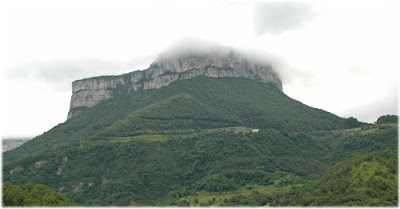
That last incident had a profound lasting effect upon me. More than anything else, Dad's statement led me here to Gamone... where I look constantly upon the giant Cournouze mountain as my spiritual "bride", my Joan of Arc.
• My charming ancestor named Frank Skyvington [1845-1916] was no doubt reacting to a taste for unusually rigorous logic when he decided that his two deceased wives should be buried in the same tomb.
• His crazy son William "Courtenay" Skyvington [1868-1959] used his aptitude for logical thinking to confirm that it was rather easy to behave as a scoundrel. His operations as a con-man were based upon the application of rigorous logic.
• My grandfather Ernest Skyvington [1891-1985] used smart logical subterfuges to abandon his unpleasant childhood universe of London and start a new existence in the Antipodes. He even used his skills in logical reasoning to escape from the threat of being killed as a soldier.
• My father "Bill" Skyvington [1917-1978] used smart logical thinking to acquire his first agronomic property and to join the war effort in an acceptable manner. His most ingenious statement of poetic logic was when he tricked me in a mild way (I was about 15) by suggesting that his bush paddock was in fact his personal "cathedral".
That last incident had a profound lasting effect upon me. More than anything else, Dad's statement led me here to Gamone... where I look constantly upon the giant Cournouze mountain as my spiritual "bride", my Joan of Arc.

If anybody were to imagine a similarity between "Cournouze" and "Courtenay", I would be obliged to say that it's a pure coincidence.
Permanent imprint
On 9 January 2015, this printing-house at Dammartin-en-Goële in the French countryside (Seine-et-Marne) made an unforgettable impression upon TV-viewers throughout the world. It was the arena of a spectacular standoff between police sharpshooters and two defiant brothers, Saïd and Chérif Kouachi, perpetrators of the murders at Charlie Hebdo in Paris on 7 January 2015.

The battered building has been totally renovated. The sparkling premises were inaugurated this morning by François Hollande.

Wednesday, September 28, 2016
Trying to find ancestors who made me smart
A few days ago, I was trying to solve the enigma of a charming ancestor named Frank Skyvington [1845-1916] whose son named William Skyvington [1868-1959] turned out to be a scoundrel. I kept saying to myself that it was strange to find a father and his son who were clearly so different. Why did this madness appear suddenly, before disappearing just as suddenly. I searched around intensely on the web to find an explanation of the ways in which chromosomes of madness might suddenly come into existence, maybe introduced by a baby’s mother. But every article I found on this genetic question was prefaced, as it were, by a huge warning: Be careful. Don’t assume that genes play any role whatsoever in the situation that concerns you. Maybe the factors that interest you were acquired, not from nature, but through nurture.
For ages, that sort of advice always infuriated me. It was unthinkable that environmental causes might have made me interested in science, then computers, then France, etc. To put it bluntly, nobody in my surroundings could have possibly persuaded me to get interested in out-of-the-way passions such as science, computers, France, etc. The only plausible explanation was that one of my ancestors must have supplied me with the necessary “good genes”.
Well, that last statement is utter nonsense. The only causes that make somebody smart come from the people who talk to him, the books he reads, the stuff he learns, etc. There are no magic genes in our bodies that turn on brightness as if we were an electric lamp.
It has taken me a long time to reach this simple conclusion.
For ages, that sort of advice always infuriated me. It was unthinkable that environmental causes might have made me interested in science, then computers, then France, etc. To put it bluntly, nobody in my surroundings could have possibly persuaded me to get interested in out-of-the-way passions such as science, computers, France, etc. The only plausible explanation was that one of my ancestors must have supplied me with the necessary “good genes”.
Well, that last statement is utter nonsense. The only causes that make somebody smart come from the people who talk to him, the books he reads, the stuff he learns, etc. There are no magic genes in our bodies that turn on brightness as if we were an electric lamp.
It has taken me a long time to reach this simple conclusion.
Not as bright as I thought I was
I’ve always considered myself as relatively intelligent. That’s what people told me when I was a kid at school. Later, I thought I was bright when I became a computer programmer with IBM Australia. I simply failed to understand that I was merely the proverbial right man in the right place at the right time. Then I thought I was bright when I moved to France, married, raised a small family, and finally became a French citizen. Once again, as in Sydney, I was simply the right Australian in France at the right time. More recently, I started to think of myself as bright when I used my Macintosh computer at Gamone to publish a couple of family-history books. The truth of the matter is that I would have been silly to not take advantage of that excellent environment to produce those books. In any case, their existence doesn’t suggest for an instant that the author/publisher might have been in any way bright, merely fortunate.
A few days ago, for the first time in my life, at the august age of 76, the truth hit me with a bang. I’m not particularly intelligent. Purely lucky. The good old game consists of being in a convenient situation at exactly the right moment. Right place and right time. There’s a tiny bundle of convenient talents in my brain, but nothing whatsoever of an extraordinary nature.
It's high time that I made this clear! To myself, above all.
A few days ago, for the first time in my life, at the august age of 76, the truth hit me with a bang. I’m not particularly intelligent. Purely lucky. The good old game consists of being in a convenient situation at exactly the right moment. Right place and right time. There’s a tiny bundle of convenient talents in my brain, but nothing whatsoever of an extraordinary nature.
It's high time that I made this clear! To myself, above all.
Subscribe to:
Comments (Atom)