
 Israel's national anthem is called Hope:
The nation's second anthem is Jerusalem of Gold by Naomi Shemer, sung here by Ofra Haza:
 New Soul by the 30-year-old French-Israeli singer Yael Naïm is an excellent theme song for Israel's 60th birthday:Israel's national anthem is called Hope:New Soul by the 30-year-old French-Israeli singer Yael Naïm is an excellent theme song for Israel's 60th birthday:
 This vague parallelism between our scientific catechism of the Cosmos and the theological notions of Christianity is, of course, superficial, and I am not suggesting for a moment that there is anything of a serious scientific nature in the Christian dogma. On the other hand, in trying to amalgamate the three dimensions of the Creation process, we run into mysteries of an almost Byzantine kind.
 The army joined in the protests, which looked at times as if they might degenerate into a riot. Inspired by a concept of the French Revolution, the general Jacques Massu set up a comité de salut public [committee of public welfare], and called upon the French president René Coty to form a government in a similar spirit of salut public.
 This crisis that flared up in Algeria created a context in which Charles de Gaulle finally decided to preside over the destiny of France.
 The events of 13 May 1958 are considered as the starting point of the creation of the Fifth Republic.
 Upon receiving this gift, the delighted cardinal exclaimed enthusiastically: "This vehicle will take me to Paradise!" Then he drove off into retirement in a Dominican convent in the village of Monteils in south-west France. In 1994, at the age of 90, François Marty attempted to drive his automobile across a level crossing in the vicinity of his village. Before he reached the other side, a train smashed into him, carrying the cardinal and his sweet chariot home to God.
 I got out of my vehicle to see what was happening, and I discovered that workers were installing a second set of rails.
 I recalled that, a few days earlier, in nearby Vinay (when I was visiting the Danisco factory), I had already viewed work being carried out upon this vast project: doubling the existing railway line between Grenoble and Valence.
 Alongside the blocked level crossing, a light-hearted publicity panel announced that, in 2009, we should think about taking the train on this line between Grenoble and Valence.
 We see passengers from an automobile, blocked in a traffic jam on an overhead bridge, sliding down a rope to catch the train.
 Although her snout is a fragile high-tech smelling device, Sophia is perfectly capable of using it like a shovel to move stones and gravel in order to bury a precious piece of fresh meat [in this case, a chicken's head] that needs to spend a few days in the soil to make it soft, smelly and tasty.
 In her Brittany home, Sophia's daughter, Gamone, now disposes of a lovely lawn on which to pursue her favorite pastime: playing with her soft red rubber ball. People get fed up being expected to toss the ball as far as possible, enabling Gamone to exhibit her talents as a footballer. Click on the following image to see a delightful demonstration of a sophisticated electronic gadget for launching tennis balls:
 Sophia is now accustomed to the daily ritual of my billy-goat Gavroche calling in for a handful of cereals, served up in a silver dog dish.
 I often say to myself that I should give Gavroche away to somebody with a few female goats, because I'm sure that my poor frustrated beast would like to get into action in the sexual domain. On the other hand, Gavroche has truly become part of the furniture at Gamone, and I would be sad to see him go. I'm currently looking into the idea of either hiring him out [free, of course] for procreative services, or maybe even accepting female goats here [in a small electric-fenced yard] for casual short-time encounters with Gavroche.
 A burglary was committed in the New York apartment of a woman who happens to be an Apple store employee, and the thief got away with TVs, iPods, DVDs and two laptop Macs. The lady had subscribed to the .Mac online service, which included a tool named Back to My Mac that enables you to use a second machine to get in contact with your home Mac, and to operate the latter in a remote fashion, just as if you were sitting in front of it. Realizing that the robber was using her stolen Mac, the lady used Back to My Mac to take control of the machine, whereupon she was able to use its built-in camera to take a photo of the robber, staring at the screen, and to receive an email copy of this portrait. She showed the photo to friends who had been to a party in her apartment, and they instantly recognized the robber, and supplied his name and address. The lady then wandered into the local police station and supplied the startled cops with a complete description of the crime, including an excellent portrait of the culprit. She immediately recovered nearly all her stolen stuff. As for the robber, if ever he were to find himself behind bars for a short spell, he might look into the idea of using his spare time to do a bit of reading about the advanced possibilities of the Macintosh.
 This weekend, representatives from many of these places named Beaufort were gathered together, a little like members of an international clan, in the tiny village of Beaufort in the Isère department, an hour's drive away from my homeplace. It's a superficial but amusing pretext for an international gathering, a little like the twinning concept. In a dynamic little community, like that of Beaufort in Isère, local citizens house the visitors in their homes, which makes the whole process simple and friendly. Meanwhile, the gathering is a platform for touristic promotion of the various Beaufort places.
 The French name has been widely exported. There's a Beaufort Castle in Scotland, in Luxembourg and even in Lebanon. Towns named Beaufort exist in the USA (South Carolina) and in Australia (Victoria).
 Yesterday afternoon, some groups of representatives organized stalls with specimens of their local products.
 As for the Australian delegates, who brought along piles of photos and leaflets concerning their town, they got interviewed on regional TV. They told me that they had been inundated, since their arrival in France, by questions from French people about tourism in Australia.
 Well, in the course of my genealogical research concerning the Skeffington family, I discovered an ancestral line that descends from John of Gaunt and his children named Beaufort. [Click the image to download an article on the genealogy of Lewis Carroll.] The four children were so named after a castle in France where they were born.
 In what part of France was this Beaufort Castle located? Most English-speaking authorities [Dictionary of National Biography, Encyclopaedia Britannica, Wikipedia, etc] indicate that it was in the Anjou region of western France, in the village now known as Beaufort en Vallée [see the photo of their stand, earlier on in this post]. This sounds like a reasonable suggestion, in that there were ancient links between English royalty and this region through Geoffrey Plantagenet, Count of Anjou [1113-1151], patriarch of the Angevin dynasty, between the Normans and the Plantagenets. In fact, two centuries later, the Beaufort Castle associated with John of Gaunt had nothing to do with Anjou, for it was located in a quite different part of eastern France, in the tiny village of Champagne now known as Montmorency-Beaufort, whose representatives were also present at the gathering this weekend.
 It's really quite remarkable that such a geographical error should continue to exist in the context of British royalty, which is surely one of the most highly-documented domains in the history of the English-speaking world. Maybe this error persists for the simple reason that the provincial facts would appear to be written, for the moment, solely in French. [I intend to publish an article on this question in the near future.]
 Uninhabited for a century, this was the birthplace of Joseph Vacher [1869-1898], often referred to as France's Jack the Ripper, a notorious serial killer who was no doubt responsible for more than two dozen heinous cases of rape and murder.
 As far as I know, the visitors at the Beaufort gathering were not taken on a touristic visit to this house.
 His latest theme is the history of slavery, as far as it affected France and her overseas territories. The president has decided spontaneously that this subject must be included in school curricula, and that the abolition of slavery will be commemorated annually, henceforth, on May 23.
 This morning, in the middle of my work, Sophia made it clearly known to me that there was no point in pursuing the job any further, because she found that the dusty rocky hollow I had created was a perfect place for a dog who wants to bask in the sun.
 Now, if you want to be long-winded about saying that two things are the same, you can add on a popular term for "donkey": C'est kif-kif bourricot. And what's the role of the donkey in this verbal construction? Well, it would appear that, in North Africa, to indicate that two things are the same, people often say that they're kif-kif... like a donkey. Like a canary, for that matter.
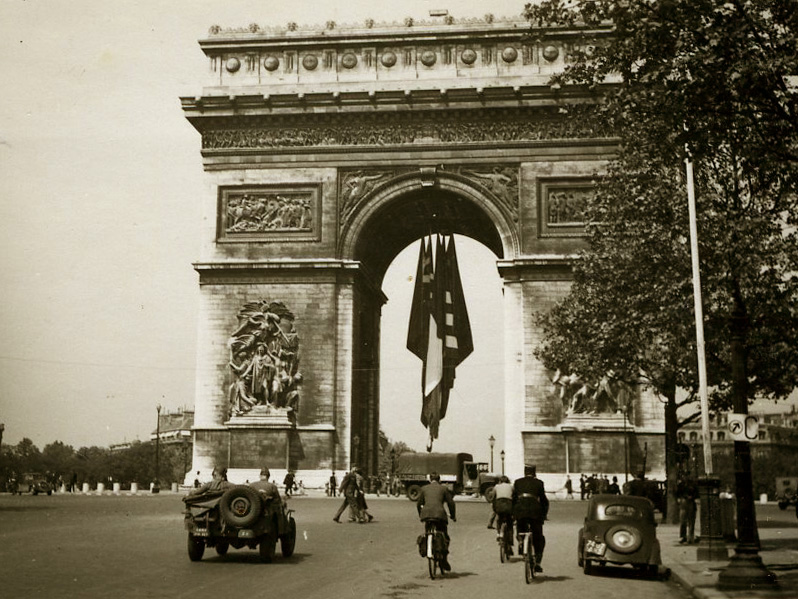 Five huge flags are suspended from the Arc de Triomphe. [Paris historians might be able to tell us whether the habit of flags under the arch dates from that epoch.] The army truck on the Place de l'Etoile has a white five-pointed star on the door. Is the Jeep a US or a French vehicle? There's a French policeman on a bicycle, surrounded by a couple of civilian cyclists and a midget automobile. On this 8 May 1945 at the hub of France, the ambiance is calm.
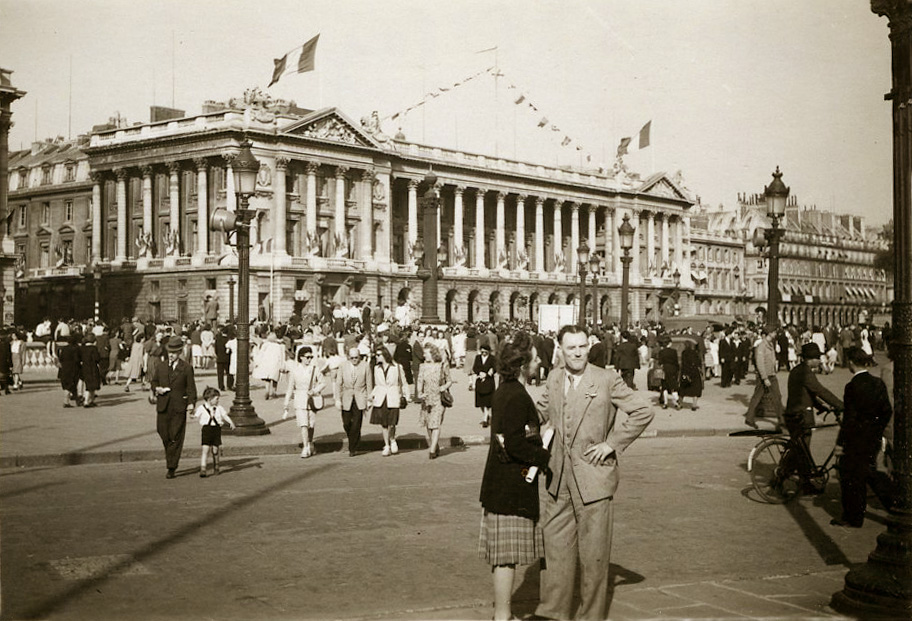 On the Place de la Concorde, the atmosphere is subdued. I have the impression that the couple in the foreground were the proprietors of Emmanuelle's flat. The man is wearing some kind of decoration in his lapel, whereas the woman seems to have purchased a poster. They appear to me as Gaullist patriots, happy to realize that Paris is once again their familiar City of Light. Everything in this photo indicates calm and sunny relief.
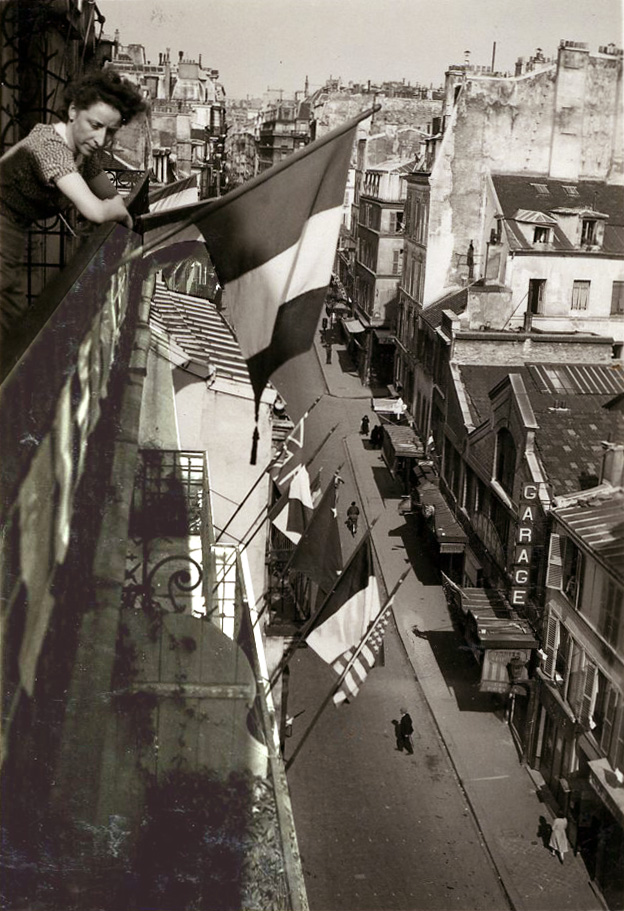 This photo was taken from the balcony of my daughter's flat in the Rue Oberkampf. The lady is probably the same person seen in the photo on the Place de la Concorde. The building is bedecked with five flags, including those of France, the USA, Great Britain and Russia.
 Once upon a terrible time, Hitler's My Combat was indeed a best-seller. Up until 1945, some 12 million copies had been in circulation. Today, the heritage of this literary and societal muck is characterized by two disturbing observations. First, the book is banned in Germany, as if the authorities were afraid that Hitler's ravings might still stir up Fascist enthusiasm. Second, it would appear that this antiquated book still has a significant readership in a nation that would like to become a member of the European Union. I'm referring to Turkey.
 Click the image to see what Wikipedia has to say about this extraordinary and obnoxious fake document, which develops the crazy idea that planetary Jewry has been conspiring to take control of the world. Indeed, the Protocols might be considered as the grandaddy of all the conspiracy theories of the 20th century, right down to all the rubbish that has circulated concerning the events of 9/11.
 A recent article in the excellent New York Times [display] drew attention to the fact that Putin has been favoring the Russian Orthodox church as a kind of unique Christian faith, at the expense of all others, particularly Protestants. Now, don't get me wrong. I'm quite happy to see that Putin's state apparatus aims to create a nice official kind of old-fashioned religious phenomenon, starring primarily, if not uniquely, the Orthodox church. Why not? This quaint time-honored image of saintly Russia will be good for tourism and public relations, not to mention foreign affairs of a political kind, and might help us to forget about Stalin. But things get more disturbing when we learn that the new generation of Russian ecclesiastics would appear to believe in, and propagate, the anti-Semitic shit promulgated by the Protocols... once authored by a Russian faker named Matvei Golovinski [1865-1920]. The circle is ignominiously closed.
 At first sight, Chatte appears to be a village, but the visitor soon discovers that it has all the trappings of a little town... such as a post office, for example, on a corner of a small square with a republican fountain with a tricolor-waving Marianne.
 The town hall is currently decked out in German and Italian flags, because Chatte is twinned with towns in these two countries. Yesterday, the town received a bus load of Italian visitors. On the narrow pavements of Chatte, there's no room to swing a female cat, so I had to step onto the equally narrow road (where automobiles travel at twice the legal speed) whenever I ran into tourists.
 It was sunny in Chatte, and the leafy trees around the church provided shade for bikers at lunch. As for the church, in spite of the influx of visitors, it remained shut.
 Chatte was the abode of a future Catholic saint, who lived in a charming stone house across from the church.
 The plaque informs us that Pierre-Julien Eymard [1811-1868] was the local priest for three years. [Click the portrait to visit a rich website concerning Eymard's ecclesiastic achievements.]
 At the center of the town, a café is called, appropriately enough, the Café du Centre. A nearby place is marked hotel/restaurant, but I'm not sure whether it's operational. The only major tourist attraction at Chatte is a small park with a collection of model railways... but I've never been motivated enough to go there.
 A tiny stream meanders gently through Chatte, past stone-walled yards of fruit trees and drooping wisteria. It surely has a source and a name, but I ignore these details.
 Nearby, the imposing façade of a former spinning mill evokes an epoch, long before our modern age of outsourcing and globalization, when the villages and small towns of France hummed with industrial activity.
 Up on a hill above the township, a nondescript stone building is referred to, by local people, as le vieux château [the old castle].
 From this vantage point, the view extends across the rich plain alongside the Isère, with fields of walnut trees and colza, to the nearby Vercors mountain range [where my Gamone homeplace is located].
 The town might appear to be somewhat drowsy, but it is actually quite a prosperous and progressive little community, with modern facilities such as this media library for young people.
 Last but not least [in fact, the main reason why I've been drawn recently to Chatte], behind this children's playground on the central square of the town, there's an excellent service in physical education, equipped to take care of prostatectomy patients.
 To the left of the main portal, we find an effigy of Clément Adrien Vincendon-Dumoulin [1811-1856], a hydrographer [map-maker] who sailed to Antarctica on the Astrolabe with Dumont d'Urville during the period 1837-1840. It's amusing to imagine a young man from Chatte in the following antipodean predicament:
 In an identical alcove to the right of the portal, a bust depicts Alexandre Collenot [1902-1936]:
 He was a daring aviation mechanic who flew constantly with the great pioneer Jean Mermoz before disappearing from the face of the Earth somewhere between Brazil and Senegal.
